

When is it better to use a sintered component and when is it better to choose another technology?
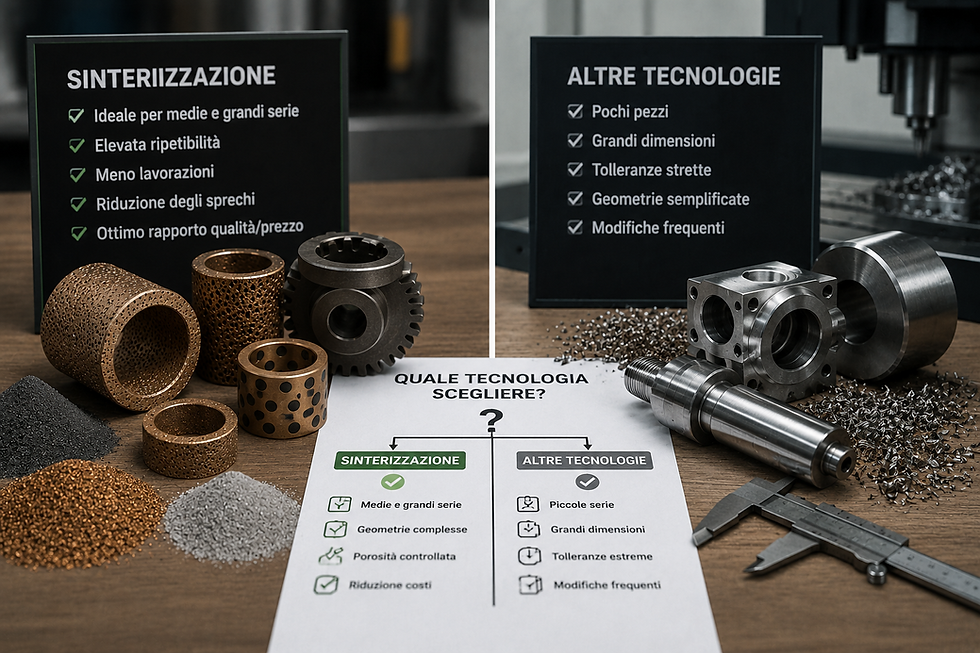
Sintering is currently one of the most efficient manufacturing technologies for producing metal components for industry. However, like any manufacturing process, it is not always the ideal solution.
One of the questions that designers, technical offices and production managers ask themselves most frequently is: when is it best to choose a sintered component and when is it better to switch to another technology?
Answering this question means evaluating numerous aspects: production volumes, component geometry, required performance, costs and subsequent processing.
In this article, we analyze the main factors to consider to identify the most suitable solution for each project.
The best technology is not the most innovative, but the most suitable one
Every production process has strengths and limitations.
The goal of a good design is not to use the most modern technology, but to choose the one that offers the best balance of performance, reliability, and cost.
Sintering stands out precisely because it allows for the production of complex components with high dimensional repeatability, reducing material waste and limiting many mechanical processes.
However, there are situations where other technologies may be more convenient.
When sintering is the ideal choice
Medium and large series productions
Sintering expresses its maximum potential when the component must be produced in medium-high quantities.
Once the equipment has been created, the process allows for the production of highly uniform pieces with very short cycle times.
Repetitive and complex geometries
Components such as gears, pulleys, bushings, cams and structural parts can be manufactured with very precise shapes already during the compaction phase.
This allows you to reduce or eliminate numerous subsequent processes.
Waste containment
Unlike chip removal processes, sintering uses raw materials extremely efficiently, helping to reduce production waste.
Components with specific functional characteristics
Some applications require properties that are difficult to achieve with other processes, such as the controlled porosity needed for self-lubricating components or for particular filter systems.
When another technology may be preferable
There are also situations where sintering may not be the most advantageous choice.
For example:
production of very few pieces;
very large components;
geometries not compatible with the compaction process;
frequent design changes during the development phase;
dimensional needs that require completely different processes.
In these cases, it is advisable to evaluate with the manufacturer which process guarantees the best result.
The cost does not only depend on the price of the component
One of the most common mistakes is to compare only the unit cost of the piece.
In reality, it is necessary to consider the overall cost of the project.
It is necessary to evaluate:
number of operations required;
production times;
amount of material used;
maintenance costs;
component lifespan;
reliability over time.
A seemingly cheaper component may generate higher costs over its life cycle.
The role of design
Involving the manufacturer from the early stages of the project often allows for more efficient solutions to be identified.
Small geometric changes can simplify manufacturing, reduce costs, and improve component performance without altering its functionality.
For this reason, the collaboration between designer and manufacturer represents one of the most important aspects in the development of a sintered component.
The DL Sintered Experience
In industrial practice, it often happens that a component is designed with a specific production technology in mind.
By analyzing the project in detail, it is possible to identify alternative solutions that allow for reducing the number of machining operations, improving production repeatability, and optimizing the overall cost of the component.
For this reason, a technical evaluation performed in the early stages of development can significantly impact both the performance and cost-effectiveness of the project.
Conclusions
Sintering is an extremely competitive technology, but the choice of production process must always be the result of a comprehensive technical analysis.
Carefully evaluating production quantities, component geometry, required performance, and overall costs allows us to identify the most effective and sustainable solution.
Relying on a specialized partner means being able to count on technical support capable of guiding the project towards the most suitable manufacturing choice, with the goal of obtaining reliable, high-performance, and cost-effective components.
Frequently Asked Questions
Is sintering always the best choice?
No. It depends on factors such as the quantity to be produced, the geometry of the component, the required performance and the overall costs of the project.
When is it best to use sintering?
Generally in medium-large productions, when it is important to achieve high repeatability, reduce waste and limit subsequent mechanical processing.
Is it possible to evaluate multiple technologies before starting production?
Yes. Analyzing the project in the initial stages allows you to compare different production solutions and choose the one best suited to your technical and economic needs.


Comments