

What are sintered components and why choose them?

Find out what sintered components are, how they are produced, and why they represent an efficient, durable, and advantageous solution for many industrial applications.
Sintering is an increasingly widespread production technology in modern industry thanks to its ability to produce complex, resistant and precise metal components at competitive costs and with excellent repeatability.
In this article, you will learn how sintered components work, what advantages they offer, and in which sectors they are used.
What are sintered components?
Sintered components are metal parts made through the compaction and subsequent sintering of metal powders.
The process takes place without completely melting the metal: it is the controlled densification that gives the component strength, hardness and precision.
How the sintering process works
1. Preparation of metal powder
A mixture of metals, lubricants and additives is formulated based on the required final characteristics (bronze, stainless steel, iron, etc.).
2. Pressing
The powder is compressed into a mold at high pressure to obtain the “green,” a solid but not yet final piece.
3. Sintering
The piece is brought to a high temperature in a controlled oven.
The metal particles bond together, increasing density and strength.
4. Any final processing
Grinding, impregnation, calibration or CNC machining, if required.
The main advantages of sintered components
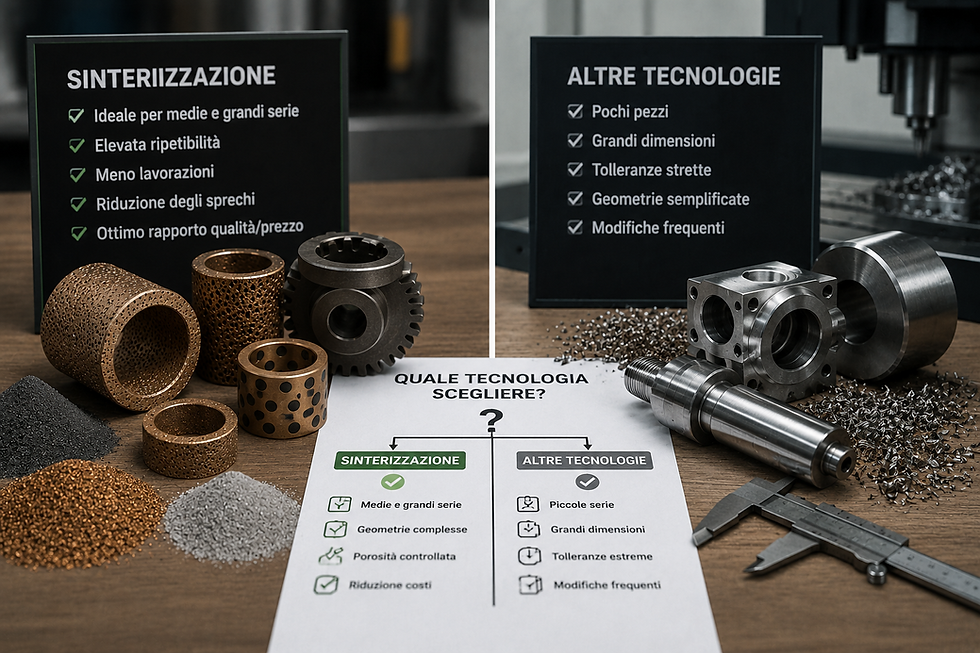
• Reduction of production costs
• Excellent repeatability of the pieces
• Possibility of creating complex geometries
• Reduction of material waste
• Good mechanical properties
• Excellent quality/price ratio
FAQ – Frequently Asked Questions about Sintered Components
1. What is the difference between a sintered and a cast component?
A casting is made by bringing the metal to a liquid state; a sintered part is not.
Sintering reduces time, costs and dimensional errors.
2. What materials can be sintered?
The most common: bronze, iron, stainless steel, brass and some special materials.
3. Are sintered components durable?
Yes, if designed correctly: they offer good hardness, thermal stability and durability.
4. Is sintering suitable for large production runs?
Absolutely yes: it is one of its main applications.
5. Is it possible to customize the components?
Yes: shape, material, density and treatments are completely configurable.
Conclusion
Sintered components represent a modern, economical and reliable solution for many industries.
Thanks to precise and repeatable production, they allow for high quality at low costs – a decisive advantage for technical and industrial applications.


Comments